
Ponzi Associate Jailed For "Mind-Boggling" Money Laundering Scheme

A New York man accused of playing a role in the $425 million Ponzi scheme perpetrated by Nicholas Cosmo had his bail revoked by a New York federal judge who called "mind-boggling" his efforts to hide over $1.7 million in illicit scheme proceeds.  Anthony Ciccone, 39, was ordered into custody by Magistrate Judge A. Kathleen Tomlinson after prosecutors detailed a multi-year scheme by Ciccone to hide nearly $2 million that he gained from Cosmo's Ponzi scheme.  Ciccone had previously pleaded not guilty to criminal charges resulting from the scheme.

Ciccone was one of the top brokers in Cosmo's Agape World, which promised investors huge returns in short-term investment contracts.  Ciccone was one of Cosmo's many brokers who were paid handsome commissions in return for steering investors into Agape World despite the existence of numerous red flags surrounding the investments.  Ciccone, who was formerly a postal worker in Manhattan, ended up receiving approximately $15 million from Cosmo in commissions.  

Cosmo was indicted on thirty-two counts of wire fraud and mail fraud, and later pleaded guilty in October 2010 to one count each of wire fraud and mail fraud. Cosmo was subsequently sentenced to a twenty-five year prison term in October 2011.  While Cosmo was originally the only one facing criminal charges, authorites later unveiled civil charges against more than a dozen brokers in June 2012, with four brokers, including Ciccone, also facing parallel criminal charges.

After Ciccone was arraigned on a superseding indictment earlier this month, Magistrate Judge Tomlinson agreed to allow him to remain free on the original $1 million bail.  However, prosecutors subsequently alleged that Ciccone had been involved in an intricate plot to conceal nearly $2 million realized from Cosmo's scheme.  According to prosecutors, Ciccone overpaid approximately $1.7 million in federal and state income taxes beginning in 2008 that was comprised of Ponzi scheme proceeds.  Several years later, the funds were returned to Ciccone in the form of tax refunds, and Ciccone subsequently had his wife and mother-in-law launder the refund money through their bank accounts.  Once back in Ciccone's possession, the funds were then used for expenses, to pay for two Florida businesses, and even for $350,000 in gold coins.  

To date, authorities have only been able to recover approximately $10 million for Cosmo's victims - representing approximately 5% of the $179 million estimated to be lost.
Ponzi Schemer Who Fled To Greece Gets 17.5 Year Prison Sentence

A Texas man who fled to Greece after pleading guilty to a $8.6 million Ponzi scheme only to be recaptured and returned to the United States was sentenced to serve more than seventeen years in prison.  Christopher Blackwell, 34, received a 210-month sentence from United States District Judge Terry R. Means.  Blackwell was also ordered to pay $8.6 million in restitution to his defrauded victims.

Prosecutors allege that Blackwell, through his companies AV Bar Reg Inc. and Millers A Game LLC, claimed to have an established trading program that could guarantee investors monthly returns ranging from 25% to 30%.  In attempting to bolster his credibility and reputation, Blackwell made a variety of representations concerning his academic and professional background.  These claims included masters and doctoral degrees from a Spanish university and previous employment at Goldman Sachs and the Bank of Madrid.  All of these claims were false.  

When federal authorities began investigating, Blackwell arranged several meetings at Hooters with an undercover agent posing as a potential investor.  There, Blackwell promised that an investment with him would be risk-free, and that he was able to generate such lucrative profits through “buddies that I went to school with” that worked at prestigious financial firms such as Goldman Sachs.  

Blackwell was arrested in June 2011 and charged with two counts of wire fraud.   After subsequently pleading guilty in July 2011, Blackwell made the decision to flee before his sentencing.  He ended up at the Greek island of Carfu, where he remained until he was arrested by U.S. Homeland Security agents in April 2013.  Blackwell was extradited back to the United States and was returned to Texas in November.  

The sentence is notable in that it is towards the high-range of sentences for the amount of losses at issue.  Indeed, of the nearly 400 sentences handed down to Ponzi schemers from 2008 to 2013 as featured in the Ponzi Database, the average and median sentence for all Ponzi schemes was 114 months and 110 months, respectively.  It is likely that Blackwell's decision to flee may have played a part in the increased sentence.  

"Habitual Fraudster" Gets 9-Year Sentence For $9.2 Million Ponzi Scheme

A Colorado man dubbed a "habitual fraudster" by the Securities and Exchange Commission learned he will spend the next nine years in prison for masterminding a $9.2 million Ponzi scheme.  Larry Michael Parrish, aka Michael Parrish, received the sentence after previously pleading guilty to a single count of wire fraud last May.  In addition to the prison sentence, Parrish was also ordered to pay $4 million in restitution to his defrauded victims.

Parrish operated IV Capital Ltd. ("IV Capital") from November 2005 to October 2009.  Parrish held out IV Capital as an investment and trading company, telling potential victims that the company had more than $20 million under management, guaranteed monthly profits of at least 2.5%, and that professional third parties would evaluate the company's accounts.  Based on these and other representations, Parrish and IV Capital raised more than $9.2 million from investors.

However, of the funds raised, less than $3 million were actually used for trading by Parrish.  Contrary to the consistent track record painted by Parrish, nearly all of those funds were lost in risky trading.  More than $5 million was used to make "profit" payments to investors, with the remainder being used by Parrish for a plethora of unauthorized personal expenses that included luxury vacations, entertainment and travel, golf outings, and a Harley Davidson motorcycle.  

Of note, Parrish had previously been the subject of an enforcement action by the Securities and Exchange Commission in which he was subject to a bar order prohibiting him from future violations of securities laws.  Some investors even found out about this after an internet search, but were convinced by Parrish that he was not the same Larry Michael Parrish named in the previous action.  

No Prison Term For Michigan Man That Helped Ponzi Schemer Launder Money

A Michigan man learned that he will not serve any jail time in connection with allegations he used his family dining restaurant to launder money in connection with a $9 million Ponzi scheme.  Douglas Edward Kacos, 58, instead received a sentence of three years of probation and fifty hours of community service.  Kacos could have received up to two years in prison after earlier pleading no contest to fourth-degree money laundering charges.  The masterminds of the scheme, Jeffrey Ripley and Danny Lee VanLiere, previously received sentences of six-to-twenty years in prison.  

Beginning in July 2006 and continuing up until January 2012, Ripley and VanLiere solicited investors for their company, API Worldwide Holdings ("API").  The pair solicited mainly elderly investors, convincing them to cash in certificates of deposit ("CDs") and other investments they owned, and once those investments matured, pressuring them to invest the proceeds in API.  The pair raised more than $9,000,000 from investors, and were later arrested in March 2012 and charged with operating a Ponzi scheme.

Kacos and another man, Thomas Doctor, began assisting Ripley with collecting funds from investors, despite authorities' allegations that the men were aware of Ripley's previous run-ins with regulators over the sale of unregistered securities.  Kacos, who operated the New Beginnings Restaurant in Grand Rapids, Michigan, began acting as a registered agent for API and opening financial accounts to receive funds from API investors.  Once these funds were received, Kacos then wired those funds to foreign destinations, including Africa and the United Kingdom, to allow Ripley to avoid detection by regulatory or law enforcement.  

Kacos and Doctor were arrested in October 2013, and maintained they were unaware of the criminal nature of their actions.

Boston Ponzi Family Sentenced to Prison for $10 Million Ponzi Scheme

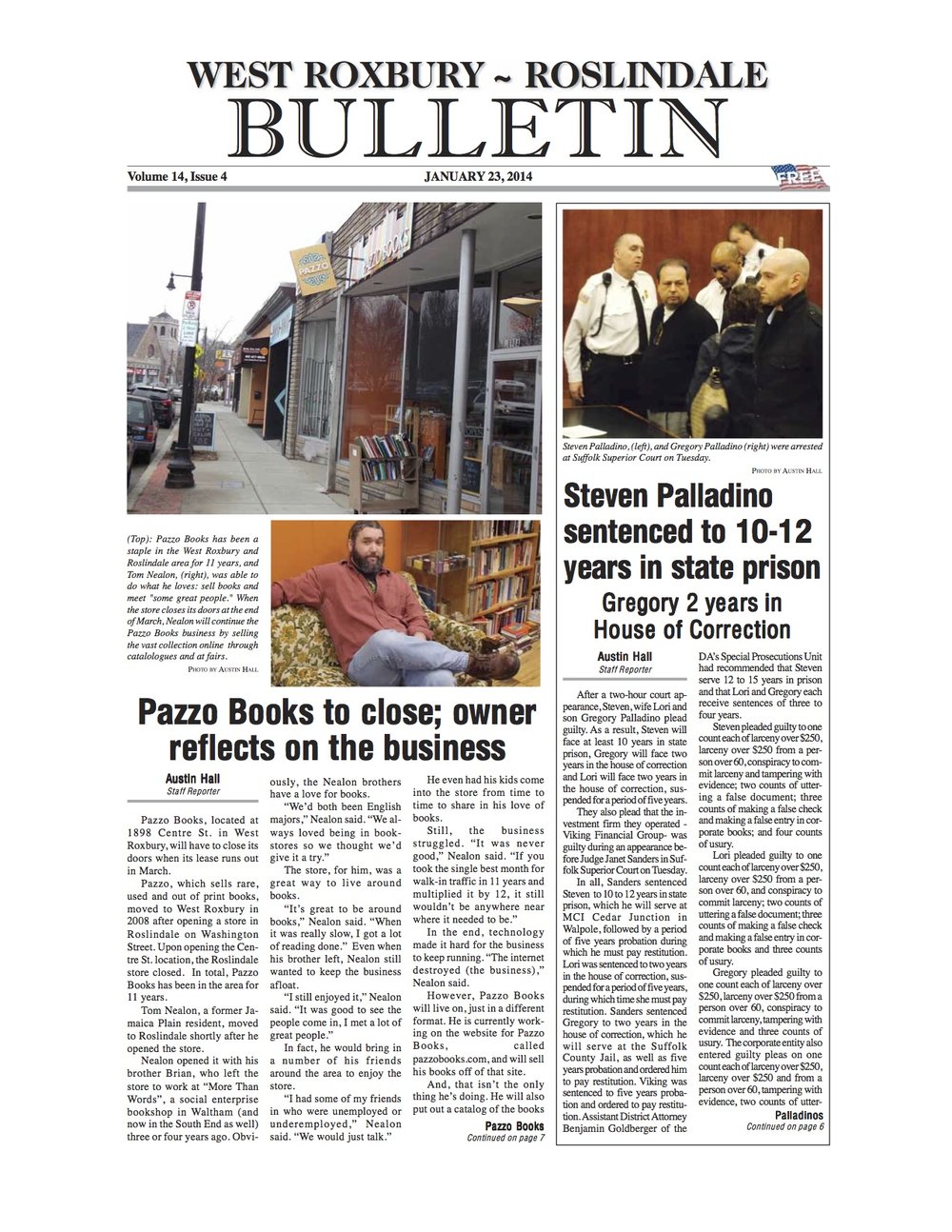
A Boston husband, wife, and son received prison sentences after pleading guilty to charges they operated a $10 million Ponzi scheme that defrauded dozens of friends and neighbors. Steven Palladino, his wife Lori, and son Gregory, entered guilty pleas before Suffolk Superior Court Judge Janet Sanders on Tuesday.  Judge Sanders sentenced Steven Palladino to serve ten years in state prison, while sentencing his son, Gregory, to a two-year sentence to be served in jail.  Lori Palladino was given a two-year sentence that was subsequently suspended for a five year period.  All three were ordered to pay restitution to victims.  Their company, Viking Financial Group ("Viking"), also pleaded guilty and was sentenced to five years of probation and ordered to pay restitution.

The Palladinos were the sole principals of Viking, which advertised itself to investors as a high-yield, low-risk investment strategy carrying above-average returns by making secured loans to borrowers at high interest rates.  These purportedly profitable loans allowed Viking to pay an above-average return to investors while still pocketing the difference for a healthy profit.  Based on these representations, Viking took in more than $10 million from at least 40 victims.  

However, in reality Viking made very few loans, and of these loans, many were made in violation of a state statute prohibiting loan interest rates exceeding 20%.  Indeed, three of the loans extended in 2007 and 2008 carried interest rates exceeding 60% - which would later serve as the basis for three usury charges against Steven Palladino.  The majority of investor funds served only to support a lavish lifestyle for the Palladinos that included Bahamas trips, rent for Steven Palladino's mistress, and hundreds of thousands of dollars in gambling losses.  Additionally, nearly $400,000 in investor funds were used to satisfy a condition of Steven Palladino's probation stemming from a 2007 conviction for, ironically enough, defrauding an elderly relative.  

The family was indicted back in September on charges that they carried out one of the largest investment scams in Boston since Charles Ponzi's infamous scheme nearly 100 years ago. Each of the three was charged with one count of larceny over $250 and larceny over $250 from a person over 60.  The three were also charged with conspiracy to commit larceny, with Gregory Palladino facing an additional three counts of usury and one count of tampering with evidence. 

Steven Palladino also faced loan-sharking charges after prosecutors accused him of seeking out an investor for repayment of a Viking-made loan.  

Previous Ponzitracker coverage is here.